
The last generation that must not be destroyed
The last generation that must not be destroyed, and must achieve victory, is Generation Z.That is why I call them Generation ‘V’, for Victory.” — Crown Prince Reza Pahlavi
hooman khalili
5/10/20264 min read
The last generation that must not be destroyed, and must achieve victory, is Generation Z.That is why I call them Generation ‘V’, for Victory.”
— Crown Prince Reza Pahlavi —
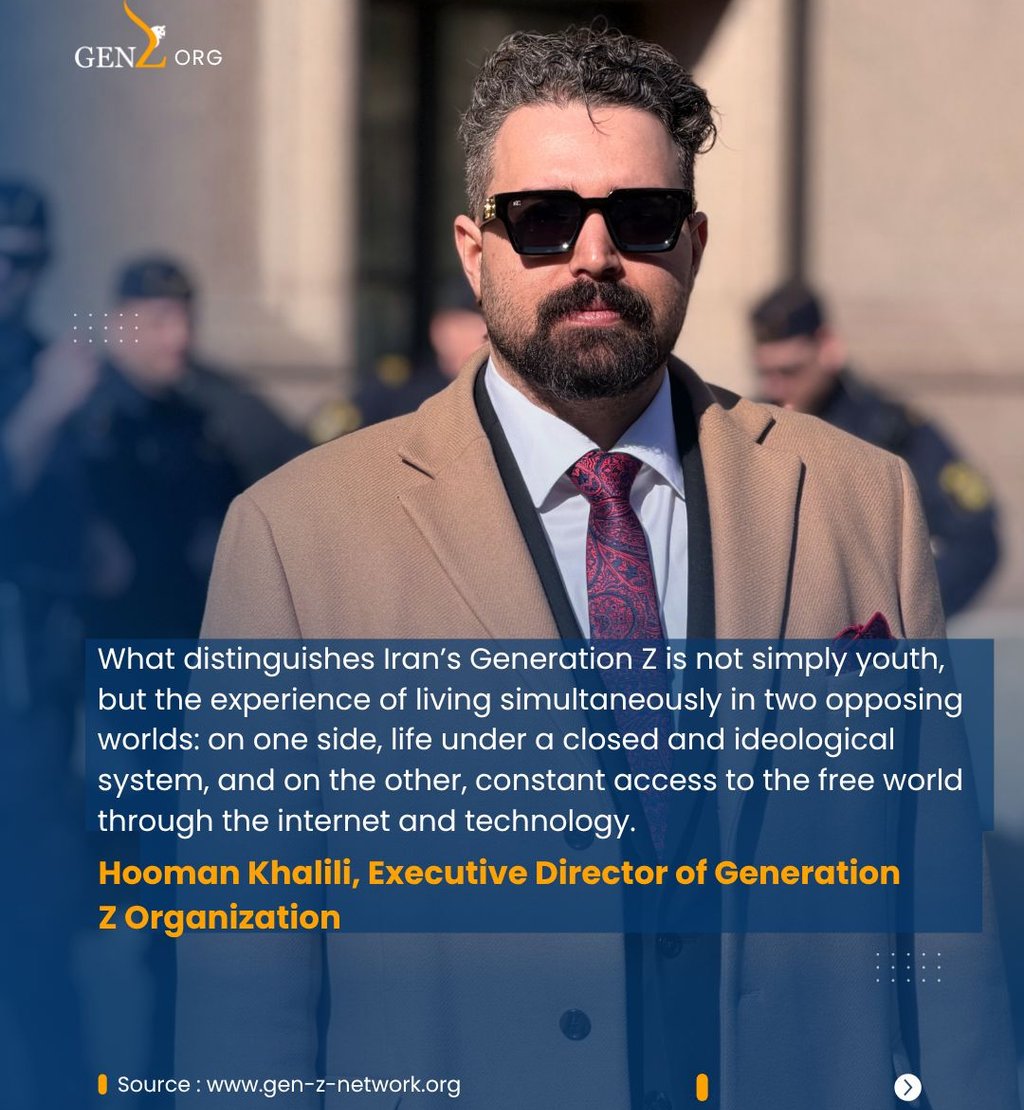
To understand this generation more accurately, we must first abandon a common misconception: generations are not defined merely by age, but by shared historical experience. What distinguishes Iran’s Generation Z is not simply youth, but the experience of living simultaneously in two opposing worlds: on one side, life under a closed and ideological system; on the other, constant access to the free world through the internet and modern technology.
This combination has created a fundamentally different generation. A generation that, within a remarkably short period of time, has reached a level of political and social awareness that in many countries is the result of decades of historical experience.
1. From Economic Demands to Structural Change
In many societies, younger generations first raise economic demands: employment, prosperity, security, and quality of life. Politics comes later. In Iran, however, this process has been reversed.
Generation Z has gone directly to the roots of the problem. Daily experience has shown them that economic crisis is not separate from the political structure, but a direct consequence of it. Corruption is not accidental or individual; it is embedded within the mechanisms of power itself. Social restrictions are not merely cultural rules, but instruments of control.
As a result, this generation no longer invests its energy in superficial reforms. The issue is not replacing individuals, but changing the rules of the game.
One of the most important differences between Generation Z and previous generations lies in their understanding of freedom.
For earlier generations, freedom was a demand. For Generation Z, freedom is seen as a natural and self-evident right.
This generation believes that:
Freedom of expression is an inalienable right.
Lifestyle choices belong to the private sphere of the individual.
Government exists to serve society, not to act as its guardian.
In the eyes of this generation, power has no inherent right to restrict freedom and then “grant” it back to the people.
2. The Lived Experience of Ideology
Many young people in neighboring countries are still captivated by ideological dreams, whether in the form of religious governments or regressive leftist movements that, despite changes in language and appearance, remain rooted in the same old logic of centralized power, political paternalism, and social control.
This generation has witnessed how:
Every absolutist ideology ultimately leads to monopoly over power.
Religion, when fused with politics, can become an instrument of control and repression.
Certain factions of the Iranian left and reformist movements, despite slogans of justice, reform, and freedom, have in practice contributed to reproducing the same exhausted structure of power.
Rather than creating genuine transformation, many of these movements merely attempted to present a more modern and acceptable face of the same ideological system.
Young Iranians have clearly observed the inaction, contradictions, and intellectual dependency within these currents.
Within ideological systems, truth is often sacrificed for survival, propaganda, and the preservation of power networks.
For this reason, Iran’s Generation Z no longer believes in ideological projects, whether religious or rooted in recycled versions of Iran’s political left.
The central demand of this generation is a system in which the individual, the rule of law, personal freedom, and national sovereignty stand above all ideologies.
3. The Gap Between the Real World and the Possible World
Iran’s Generation Z lives within a permanent contradiction. Through the internet, they are partially connected to the free world, yet in reality they remain trapped inside a restrictive structure.
Every day, young Iranians witness how their peers across the world live, what opportunities they possess, and how they shape their own futures. Under such conditions, it becomes impossible to view the existing situation as natural or inevitable.
This constant comparison acts both as a motor of dissatisfaction and as a motor of awareness.
Previous generations still hoped for reform from within the system. Generation Z, however, has largely concluded that the current structure lacks the capacity for fundamental reform.
When a generation reaches the conclusion that:
The system is not reformable,
Power is not accountable,
And the political structure remains closed,
that generation moves beyond reform and enters the stage of transition.
Iran’s Generation Z stands precisely at this point.
4. Why “Generation V”?
The reason for this name lies in three defining characteristics of this generation:
1. Clarity of Vision
This generation not only knows what it rejects, but also possesses a relatively clear image of the future it desires.
2. Premature Political Maturity
Without passing through long historical cycles, Generation Z has developed a deep understanding of how power functions. The issue, for them, is not limited to individuals or public figures.
3. Sustainable Demand for Change
This generation does not seek change alone, but guarantees against the return of authoritarianism. Its concern is preventing the reproduction of oppressive power structures.
5. A Structural Understanding of Power
Many political movements throughout history believed that the problem could be reduced to a single individual or a limited group. As a result, they focused entirely on removing that figure. Yet the structure of power itself remained untouched, eventually reproducing a new form of authoritarianism.
Iran’s Generation Z has, to a large extent, moved beyond this stage.
This generation understands that power does not exist solely at the top of the political pyramid. It is distributed through networks of institutions, laws, economic relations, and cultural mechanisms. Power is a system, not a person.
For this reason, this generation emphasizes institution-building: an independent judiciary, free media, non-ideological education, a competitive economy, and the rule of law.
At this point, the central question shifts from “Who should govern?” to “How should governance function?”
6. Leadership and Transition
At the same time, this generation has reached the conclusion that achieving these goals requires a defined framework of leadership and political order. This is where names such as Pahlavi enter the discussion, not merely as nostalgia, but as a conceivable model for stability and transition.
This structural understanding of power, which Generation Z has developed, can also be observed in the Pahlavi doctrine and in the political vision associated with Crown Prince Reza Pahlavi, particularly through initiatives such as the Prosperity Project and the Emergency Charter.
What strengthens this perception is the emphasis placed on concepts such as:
A modern state,
Secularism,
Rule of law,
The reintegration of Iran’s economy into the global system,
And sustainable institution-building.
This generation does not merely reject the current order; it also possesses a vision for the future. It has moved beyond pure emotional reaction and toward organization, network-building, and institutional understanding.
From this perspective, “Generation V” is not simply a name. It is the description of a generation that sees politics not as reaction, but as a project for redesigning Iran itself.